


The First Chapter of Two For The Road — Our First Matches at Princes Golf Club
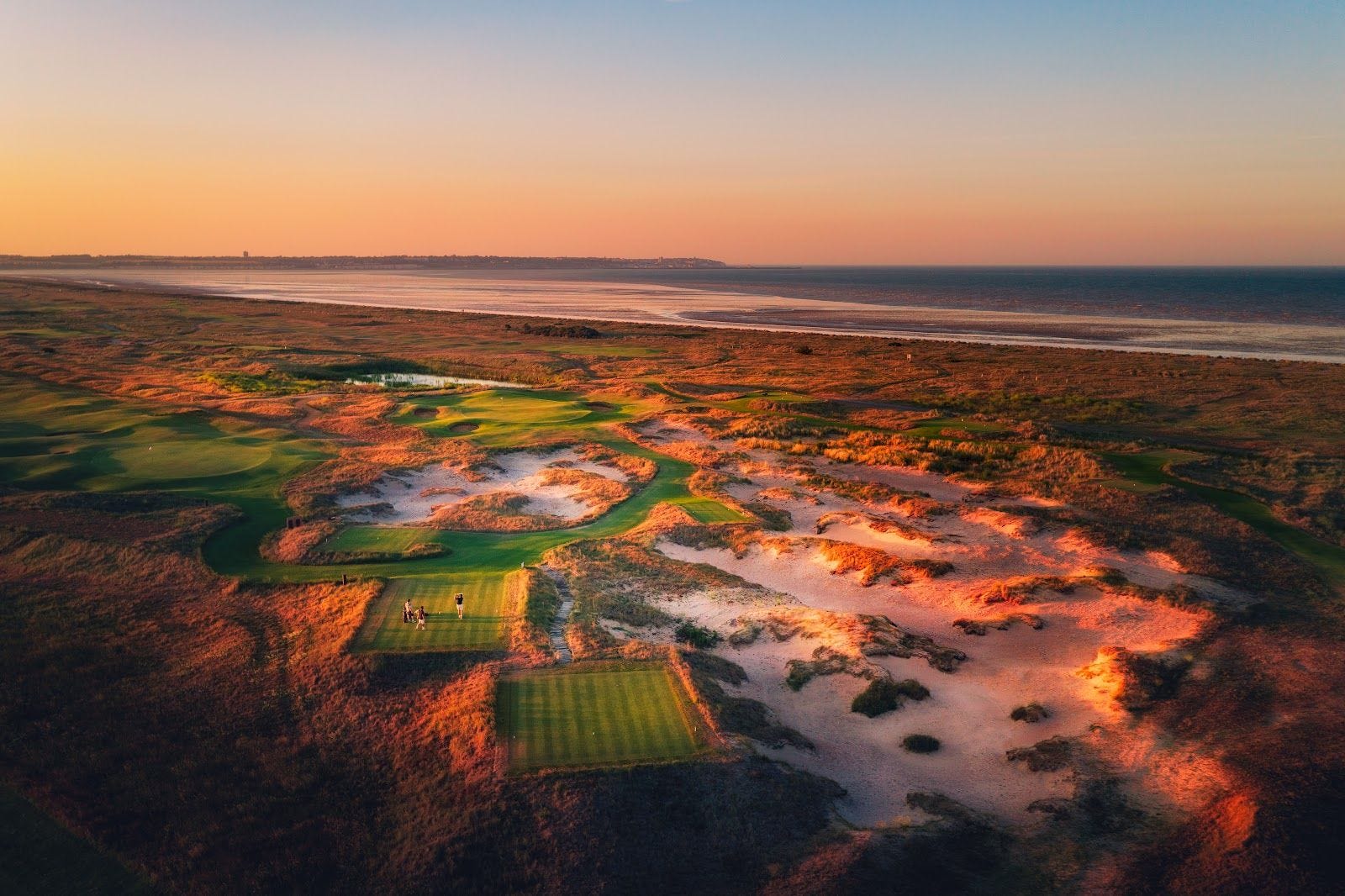
ON THE ROAD to Princes Golf Club and its celebrated neighbor Royal Cinque Ports on the Kent coast – better known as “Deal” — a plummy-voiced weather girl on Radio Two offered a promising afternoon forecast of “light breezes and abundant sunny spells in the east. Quite the lovely day.”
On the other hand, she pointed out that we’d arrived on a Friday marking the end of summer term for English school children. “As a result, dearies,” she trilled, “the motorways are going to be a perfectly ghastly this weekend. Better call ahead and tell granny you’ll be late arriving!”
Right on que, as we rounded a curve, we ran slap into a three-mile tailback of dead-stopped family-packed autos and lorries waiting to cross the Chunnel to France.
“I think we must have missed the turnoff,” I grumbled. Patrick, our alleged navigator, checked his GPS. “Nope. Apparently, we only have to get past the entrance to the Chunnel then through Dover to the Deal Road. My phone says it’s still about ninety-five minutes to Princes.”
“Which will only make us ninety minutes late for our tee time.”
Over the next half hour, during which we possibly moved only a quarter of a mile, Patrick used his time to phone home to say good morning to wife Terry and check in with a company that was building plexiglass security display cases for Lowes that he’d helped design, a device intended to stem a plague of daylight merchandise theft from America’s home improvement stores.
He finally hung up and looked over at me.
“What’s up? You look bored.”
“Nope. Just thinking.
“About what?”
“Remembering a great story Gene Sarazen told me years ago. It’s my favorite golf story and one reason I’m keen to play Princes.”
“Right, so you knew Gene Sarazen?”
“I met him on a summer afternoon in 1989 up at Lake Sunapee Country Club in New Hampshire.”
The head pro at my club in Brunswick, Maine, I explained, had previously been the head man at Lake Sunapee before he came to my club in Maine. Chris and Sarazen were old friends. The Squire, as he was nicknamed, was the first player to win the professional Grand Slam and seven major championships, which is why I jumped at the chance to meet him, one of the greatest players of Golf’s Golden Age. My buddy Chris arranged for me to drive over and play the course and meet him for my column in Golf Magazine.
“Good guy?”
“Absolutely delightful. We rode in his cart together for nine holes. I hit shots and he told me about inventing the sand wedge and winning the British Open with it at Princes in 1932 with the help of an elderly caddie named Daniels. It’s my favorite golf story.”
Patrick smiled. “Since we’re going nowhere fast, Tonto, let’s hear it.”
I was happy to oblige, giving him the delightful extended version.
The story really begins in1928 when Sarazen and Walter Hagen are traveling together by ship to the British Open Championship, which The Haig had already won twice in 1922 at Royal St Georges and two years later at Hoylake. As the two sat having a drink in the smoking lounge of their ship, Sarazen confided to his friend and rival that the one championship he desperately hoped to someday win was the British Open. He voiced the common belief that a golfer could never be considered “great” without a claret jug in his possession.
“Gene,” said Hagen, “you can never win the British Open unless you have a caddie like the fellow I’ve had over there when I won.”
Ordering another round of scotches, The Haig graciously offered to loan Sarazen the caddie who’d helped him win two British Opens.
“His name is Skip Daniels. He’s an old fellow, caddies only in the county of Kent, just at Royal St Georges, Deal and Princes. No other clubs. He’s also very particular about the men he caddies for. One thing more. He’s expensive. He’ll cost you ate least thirty of forty pounds.”
The Squire waved off the cost and happily accepted Hagen’s offer.
Daniels, the story goes, was heartbroken not to be on Hagen’s bag for the 1928 Open Championship, but agreed to help Sarazen win the event. “He was an old boy, all right,” the Squire told Herbert Warren Wind decades later. “Around sixty or sixty-one, old even for a professional British caddie. He wore a weather-beaten cap, an old celluloid collar, and a black oxford suit that had never been pressed in its lifetime. I think I fell in love with him at first sight.”
The veteran caddie had a wonderful effect on Sarazen’s game and his confidence soared during their ten days together. Moreover, Daniels knew every inch of St George’s historic course and even showed his client where he’d patrolled sand dunes along the Kent coast as a member of the home guard during the First World War. Sarazen made up his mind to heed his caddie’s every instruction.
Things went beautifully, however, until the fourteenth hole of the Championship’s second round, a challenging par-five called the “Suez Canal” fronted by a deep ditch. Against his caddie’s advice, despite a lie in the rough, Sarazen went for the putting surface in two and wound up making double bogey, finishing with a disappointing 76. Following a third round 73, religiously minding his caddie, he started the final round just one stroke behind the leader, Hagen, who finished early and came out with his friend the Prince of Wales to watch his only serious challenger finish. Owing to the Squire’s untimely double bogey in round two, however, Sarazen came up short and Hagen collected his third British Open title.
“The difference between our totals,” he told Wind, “292 and 294, was due to my bonehead refusal to heed Daniels’ advice on the Suez Canal.”
Four years later, the 1932 Open returned to Princes but Sarazen made up his mind to skip it. With painful memories of similar failed attempts at St George’s in ’28, Muirfield in ’29 and Carnoustie in ’30, not to mention with money that tight due to the deepening Great Depression back home, The Squire resolved that chasing golf’s oldest championship was worth neither time nor money.
Fortunately, his wife, Mary, had other ideas.
Before her husband could say no, she booked his travel and arranged a room at a Sandwich hotel. “The only thing you have to do, Gene,” she told him forcefully, “is to get your passport fixed up. You’re sailing a week from tomorrow on the Breman.”
Sarazen enjoyed a pleasant ocean crossing, this time in the company of Fred Astaire. who introduced him to an old friend from London who invited Gene to play a friendly round at Stoke Poges before Open qualifying. Saracen accepted the offer and carded a brilliant 67 with an aggressive young caddie on his bag. The caddie offered his services for the approaching Open because, as he brazenly put it, “old Skip Daniels has not only lost his eyesight but has been very ill of late. He’s too old to carry your bag, sir. You’d ruin your chances if you took him on. The way you played today, sir, you can’t miss.”
With reluctance, the Squire hired the younger caddie for the Championship.
Ironically, the first person waiting to greet Sarazen at the Princes pro shop was old Skip Daniels. “I could see that the last four years had indeed taken a toll on him. He had become a very old man,” Sarazen remembered. “His limp was much more obvious. And his eyes, they didn’t look good.”
“One of the hardest things I ever had to do,” he admitted to Wind, “was to inform Daniels that my bag was indeed too heavy, so I planned to go with a younger caddie.”
“Righto, sir, if you feel that way about it,” Daniels conceded, visibly wounded.
“There was great dignity in the way he spoke,” Saracen confided to me on that perfect summer afternoon at Lake Sunapee. “As [Dan] walked away, I couldn’t help feeling like the biggest heel in the world.”
London’s bookies rated Sarazen and Hagen as the men to beat, with The Squire a slight favorite to win.
But the young caddie from Stoke Poges clearly did not suit him.
During their practice rounds, he had Sarazen training like a prizefighter, doing roadwork in the morning and relentlessly practicing in foul weather that drove other contenders indoors. Moreover, his bossy young caddie criticized his club selections and chided him for the slightest miss-hit shots.
With two qualifying rounds looming, Sarazen feared that he’d made a catastrophic mistake. A member of Princes who served in the House of Lords came to his lodgings to let him know that Skip Daniels was not only broken-hearted, but still available. Moreover, it was clear to everyone that Sarazen and his young caddie were not remotely in synch.
“Daniels thinks he can straighten you out, however, before the bell rings,” the member added.
The next morning, Skip Daniels was waiting on the steps of the hotel. “Dan and I went to work. It was miraculous how my game responded to his handling. On our first round together, I began to hit the ball again, just like that,” The Squire recounted.
Over the next two days, Sarazen followed Skip Daniels’s explicit instructions how to play every hole, with a confidence that began to rise. “If we can avoid taking another 7, Dan, I don’t see how we can lose,” Sarazen predicted. “You’ll be calling the shots, and I’ll be playing them.”
The qualifying field played one round on neighboring Royal St Georges and one on Princes. On the second day, as he was shaving, Sarazen looked out his window and saw a hunched-over Daniels diagraming a green in a gale off the English Channel. It almost brought tears to his eyes.
In a light coastal breeze on day one of the championship, The Squire cruised around Princes to post a 70 that led Percy Allis and Mac Smith by a shot. With Daniels calling the shots “flawlessly,” he tied the course record with a 69 in round two, a halfway total of 139 that gave him a three-shot cushion over the nearest contender, Percy Allis. On the final day of double rounds, Daniels guided his client brilliantly through a challenging third round that included only a couple minor miscues to finish with 70, four under, five strokes ahead of Arthur Havers.
If the pressure and the pace of the tournament was telling on Dan,” Saracen told Wind, “he didn’t show it.” The Squire played masterfully over the final 18, finishing with 74, even par, for a total of 283, the lowest score in sixty years of the Open Championship.
His 13-under par clipped two strokes off the British Open record set by Bobby Jones at St Andrews in 1927. Moreover, Sarazen had led the championship wire to wire.
After a shower, the new champion got dressed for the presentation ceremonies and asked officials if Daniels might be permitted to stand beside him for the presentation of the Claret Jug. Citing tradition, however, they politely declined the request. Nevertheless, unable to spot Daniels anywhere in the crowd, Sarazen delayed the ceremony until he spotted his caddie coming down the club driveway on a wobbling bicycle with a wee grandson on each handlebar.
After the ceremony, the team of Daniels and Sarazen got together for a tearful goodbye. Sarazen gave old Dan his fancy handmade polo coat and informed him that he would be looking him up for “next year at St Andrews.”
The Squire recalled with emotion: “I waved to him as he pedaled happily down the drive, coat flapping in the breeze, and there was a good-sized lump in my throat as I thought of how the old fellow had never flagged for a moment during the arduous grind of the tournament and how, pushing himself all the way, he had made good on his vow to win a championship for me before he died.”
That was the last time Sarazen saw his friend Skip Daniels.
A few months later, English friends wrote to inform him that “Old Dan” had passed away following a short illness.
They explained, however, that following Sarazen’s triumphant win Princes, Daniels wore his polo coat every day for the rest of his life, including into the local pubs where he told anyone who would listen how he and Sarazen conquered Princes with his wondrous new sand wedge.
As The Squire told his friend Herb Wind, “When old Dan died, the world was poorer by one champion.”
“THAT’S QUITE a story. I can see why you wanted to come here first,” Patrick said as we pulled our trolleys along the first fairway of Princes’ beautiful Shore Course. It was already four-thirty on a golden afternoon, but owner Rob McGuirk was kind enough to send us out promising we could get in a full eighteen tomorrow due to the lingering light of English summer that lasts until ten p.m.
“I suppose you told me about Old Dan to make a point about getting older,” the puckish Irish Antichrist speculated. “A fitting theme for a long walk over the links by a couple elder gentlemen.”
“Maybe. But old Skip Daniels never said farewell to golf.”
“No. He just died – probably in a pub or on a golf course.”
“I’d be happy to go like that after holing a fifty-foot birdie putt to close out in our final match,” I came back at him. “Maybe at Westward Ho!”
Patrick laughed. “Please don’t do that. I’d hate to have to ship you home in your own golf travel bag.”
“No need to. Just bury me in a comfy nice coastal dune.”
I nodded at the gently rolling fairway ahead of us, thrown into gorgeous bas-relief by the sinking sun and framed by waist-high late-summer seas grasses full of larks and other small darting birds.
“So, what do you think of Princes?” I asked my companion.
“Really spectacular. Who did it?”
“Originally Guy Campbell with help from crusty Herbert Fowler of Walton Heath fame.” Our pal Donald Steel’s protégé, Martin Ebert, I explained, had remodeled the course and added a restored third nine in recent years.
I was tempted to tell him Prince’s own remarkable story, a true tale of war and rebirth that I’d boned up on just for the occasion. But it was time to play golf before daylight and energy abandoned us. Over the next ten days, the plan was to play at least a dozen nine-hole matches with a one stroke penalty for lost or unplayable shots.
After we each opened with a pair of double-bogeys on the Shore Course’s first hole, a stout 424-yard par-four, both slipped into a familiar playing rhythm that carried us along in silence to the ninth hole. Between us, the card showed eight horrifying double bogeys, four apiece, due mostly to tee shots that bounced off the generously wide but firm and rolling fairways n’er to be seen again in the lush bird kingdom of waving sea grasses. The only difference between our matching 47 strokes was the two strokes I was obliged to give my opponent on holes four and eight – providing an opening two-up win for the Irish Antichrist.
“Are we really that awful or is the course that tough?” Patrick wondered as we headed for the first tee of adjacent Dunes Course, pausing only long enough to duck into the club’s handsome upstairs lounge to grab a beer and look at a replica of The Squire’s historic sand wedge hung on the wall behind the bar. The original, we learned from owner McGuirk, was safely in a bank vault in Sandwich. We quickly downed chilled pints of lager and made haste before evening light and strength left us.
“It’s all about the bounces over here,” I reminded Pat (and myself) pointing out that seaside golf in Britain is exclusively a ground game affair. “We need better run-up games.”
Happily, our journey around the Dunes Course provided a handful of strokes better for each. We both parred the opening two holes but Pat’s extra stroke on the lengthy first hole put him one-up in our second nine-hole match, which I claimed back with a birdie on the difficult par-five third. His spent his second given stroke on the number one index par-four fourth, however, which placed him back in the lead. We played level over the next two holes until my bogey to his double on the seventh put us all-square with two to go. We both made pars on the beautiful sand-gridled eighth hole, a par-three gem of 186-yards. The ninth was a handsome brute, which I foolishly attempted to reach -- ala Gene Sarzen in ‘28 -- and saw my well-hit three-wood shot bounce violently into the face of a deep fairway bunker a dozen yards shy of the putting surface.
“Where’s Old Daniels when I needed him?” I groaned at my foolish attempt.
“Probably buried with your ball in that bunker.”
Patrick, on the other hand, played three smart shots followed by a short chip from the fringe that nearly holed out. The two shots I needed out of the bunker finished me off with an untidy six, giving my opponent his second match victory of the day. Our respective totals of 39 and 42 on the Dunes at least gave us bit of hope for the morrow.
OWNER ROB McGUIRK had already gone home for the evening, leaving word that we should meet the next afternoon at the club history room at Prince’s Lodge where we were staying just down the coast from the club.
So, we made a beeline into the ancient town of Sandwich for supper at the historic Bell Hotel pub by the River Stour, the place where Medieval warriors and Open competitors have rested their heads and slaked their thirsts since the 13th Century.
The pub was buzzing that Saturday night. Pat the wine connoisseur ordered his usual expensive red plonk and I had a potent locally brewed porter. A boisterous young family was seated at a table next to us, carrying on loudly as they devoured a frightening “tower” of classic fried pub foods that looked so inviting we foolishly ordered the same thing to share.
“You were unusually quiet out there,” Pat said. “Everything okay?’
I sipped my beer and said I was fine, just weary but pleased that flashes of our normal games finally arrived before sunset.
He smiled. “That’s one of those golf courses I could play every day of my life.”
I agreed. “Actually, I was thinking how Barry would have loved playing these matches with us. I miss him.”
“He’d have loved it. But he would have clobbered us both.”
Barry Weitzel was our dear friend who’d recently passed away following an extraordinary six-year battle against lung cancer, a charming older member of the “Starmount Seven” that, as noted, Patrick and I played with every Saturday morning from spring to fall. At 78, forever puffing away on a Casa de Garcia cigar forbidden by his physician, Barry played to an index of six and displayed a joyful gusto for life and golf that was beyond infectious. Maybe more importantly, in our merry band of older golfers, Barry was the only guy who could give Patrick the needle as sharply as he administered to the rest of us.
The day before Barry passed, his wife Suzy invited us to come by the house to say goodbye to our dear friend. Patrick and I were the last of the group to visit. The Wetzel clan had gathered to be with their fading patriarch. Suzy accompanied us into the bedroom where Barry was conscious but rapidly slipping away. He saw us and managed a fractional smile and nod of hello and struggled to speak. Suzy leaned over to listen, explaining that the unsinkable Barry Wetzel wished to know who’d won our golf match that Saturday morning.
“Unfortunately, the Irish Antichrist was up to his usual tricks,” I reported. “Needling us all into submission,” I said.
With a faint but clearly amused smile, Barry nodded, then struggled to slowly raise his right hand – elevating, in the process, a bent middle finger aimed directly at Patrick.
We laughed so hard we cried.
It was the perfect farewell from the unsinkable Barry Wetzel.
“God’s getting a great new golf pal,” Patrick said quietly as we left.
PRINCES GOLF CLUB owns a most unique history.
Opened by a former prime minister in 1906, it was among the first “modern” golf courses built to accommodate the controversial Haskell rubber core ball. A trio of Royal and Ancient Golf Club members, including crusty Herbert Fowler of Walton Heath fame, had a hand in creating the golf course in 1904. Despite Princes length and difficulty, upon its opening in 1906, the club welcomed women members and became a popular getaway spot with London elites and vacationing Parliamentarians. Four years after its opening, the great Bernard Darwin was fulsome in his praise for Prince’s greens. “There they have really beautiful greens, big and rolling and a joy to putt on.”
During the First World War when Skip Daniels patrolled its dunes in search of German invaders, however, a full detachment of British troops occupied the original clubhouse and manned anti-aircraft guns burrowed in the dunes. Princes and its two nearby sister clubs along the shore – Deal and St Georges -- were in fact all requisitioned for use by the British army but Princes suffered the most collateral damage. To protect the course’s greens, then-club secretary Percy Lucas and his son, Laddie, fenced them off, which enabled Princes to recover in time to host the British Open won by Gene Sarazen using the newly created sand wedge that he invented after flying with Howard Hughes and reportedly learning the aeronautic principals of “lift.”
In 1922, legendary British women’s champion Joyce Wethered captured the Women’s British Open at Princes, which went on to host scores of national men’s and women’s championships including the Curtis Cup and half a dozen Oxford and Cambridge matches throughout the 1920s and ‘30s.
Not surprisingly, the coast of Kent also became the frontline of defense for Britain during the Second World War, with Princes serving as a military training ground guarded by minefields and barbed wire. The British Navy used its greens for target practice – ‘Like throwing darts at a Rembrandt,” sniffed blueblood member.
Laddie Lucas, the boy who helped his father preserve the greens during WW I, became a celebrated fighter pilot for the RAF who guided his badly damaged Spitfire across the Channel following a dogfight and managed to crash land in the marsh just beyond the ninth green of the present-day Dunes course. His longtime friend and frequent golf partner, journalist Henry Longhurst, sent promptly sent him a congratulatory telegram that read: “Out of bounds again, Lucas!”
Laddie Lucas, Britain’s top amateur at the 1935 British Open, at the time regarded as the finest left-handed amateur in the world, once played the Princes course blindfolded in only fifteen over par. After the war, he played on the British Walker Cup team in 1947 and captained the squad two years later. He also enjoyed a highly successful career as a columnist for the Sunday Express and later became a popular member of Parliament. Laddie Lucas, the guiding spirit of Princes Golf Club, died in 1998. In his memory, a popular golf tournament for boys and girls aged 8–13 years, the “Laddie Lucas Spoon,” is held annually at Princes.
After the war, new owners advanced a scheme to restore the club’s “lost” original nine destroyed by the war. Architects Guy Campbell and John Morrison employed morder techniques to create an entirely new nine holes, enhancing its stature as one of Britain’s outstanding links courses. The original clubhouse was also renovated.
When new owners Ramac Holdings acquired the property in 1976, a new watering system was installed for all 27 holes. Further improvements came when the old clubhouse gave way to a sparkling modern one located in the middle of the club’s three nine-hole loops, each of which begins and ends at the clubhouse. Not long afterward, a plan to protect Prince’s ecologically valuable dunes and sea grasses, which have existed since the days of Elizabeth I, was formally put in place in perpetuity as a “Site of Special Scientific Interests,” home to unique coastal flora and fauna including native larks, kestrels, oystercatchers, terns and several species of European migratory birds.
EARLY THAT QUIET Saturday morning, Patrick and I managed to unlock the code on this Prince of English golf courses. Playing a final 18 holes over the Shore and Dunes nines, the IA’s fancy retooled Hogan clubs claimed an opening one-stroke victory on the Shore for a three-up margin in our matches. But halfway along the Dunes, mercifully, I finally found my groove and chalked up my first win by three strokes. Cobbling together a reasonable 79.
Following our match, we visited with Rob McGuirk at the Princes History Room, discovered that our host was two years old when his father took charge of Princes and modernized it without compromising the historic links.
“My father was a true working man who saved every extra penny he earned for decades in order to purchase Princes,” McGuirk explained while showing us historic photos and guests signatures that included British royalty and various American film and sports stars including a fellow named Arnold Palmer, who was so impressed by Princes during a visit in the 1960s. he looked into purchasing the club.
“For my dad, Princes was meant to always be a family affair,” Rob explained, noting that he and his five brothers and one sister all grew up playing the course, “Three of whom became professional golfers. The rest of us still play off seven.”
He also reminded us that Princes has never been a private club. As a public course anyone can play, it nevertheless boasts 250 British paying members with fifteen overseas American and Germany members, respectively, with a wait list of more than two hundred.
“We would love to have more American golfers come here,” he told us at the door before we set off down the beach for Royal Cinque Ports. “We’re a bit off the beaten paths perhaps, but Princes has always been a most welcoming place for Americans, as Gene Sarazen discovered when he finally won his Open Championship here in ’32. He called Princes the finest golf course in all of Britain.”
We thanked our host for his hospitality and stories and agreed that it was hard not to concur with The Squire, who authored one of the greatest stories in golf at this Prince of English golf courses.
Jim, great read! I forwarded your story to Rob McGuirt. He’s a member here at AAC. Looking forward to the second story. Merry Christmas! Bud T
This article comes at the perfect time. It makes you wonder, what if the weather girl's crystal ball was hooked into a real-time traffic predictin model? Would your navigation have rerouted you before you even left, or would that ninety-five minute estimate just keep dynamically adjusting? Such a relatable read.