

The Real Deal
Good Laughs and a Wild Finish at Royal Cinque Ports

A Third sneak peek at Two For The Road, a work in progress.
THAT SUNDAY AFTERNOON we met Royal Cinque Port’s beloved professional Andrew Reynolds in his tidy, old-fashioned pro shop. The club is best known by the name of the working-class seaside town where it exists – Deal.
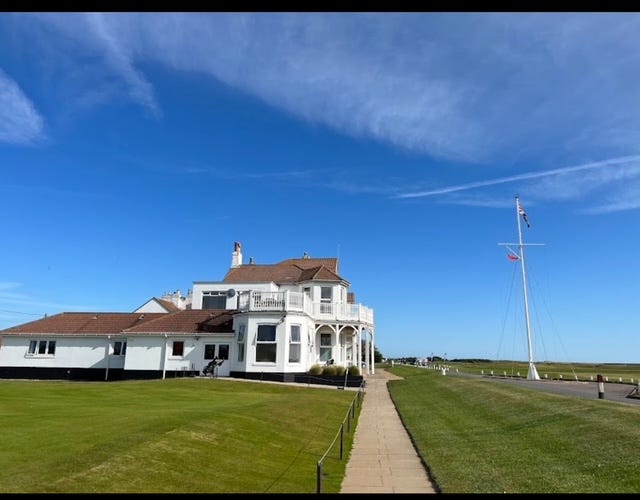
As at most traditional British clubs, the professional’s shop is housed in a modest white cottage set apart from Deal’s stately clubhouse, a Victorian sugar cube with a famous viewing porch overlooking the golf course and English Channel. As Donald Steel wrote in his introduction David Dobby’s fine history of Deal, quoting former captain of the club Bernard Darwin, “there is no view like that through the big plate-glass window of the clubhouse.”
The distance between clubhouse and pro shop is no accident, rather a reflection of the typical golf professional’s yeoman status as an independent operator who, in earlier times, was rarely permitted access to the clubhouse proper, a policy common across the world of golf until a famous incident at Deal helped change the status of golf professionals everywhere.
Deal’s first Open Championship was held in 1909, won by the great John Henry Taylor (fourth of his five Open titles) and was scheduled to host its second Open until WWI broke out in 1914, at which point, the Open was cancelled for the duration. With the resumption of golf’s oldest championship there in June 1920, public interest was surging, fueled in part by the scheduled appearance of glamourous American star Walter Hagen, making his Open debut in a field of 82 players – 74 professionals and eight amateurs.
At 6,575-yards, Deal was regarded as the ultimate long-hitter’s golf course, reportedly built by a crusty Scottish doctor named Laidlaw Purvis who grew so disgruntled by the slow pace of play at Wimbledon he convinced a couple of his golf companions to climb the tower of St Clement’s Church in Sandwich to survey the nearby coastal terrain in search of a good spot for a new golf course. This likely apocryphal story holds that the trio spotted an ideal stretch of coastal land near the town of Deal, but the good doctor’s partners ultimately preferred a more inland patch that was more protected from winter storms, whereupon they established neighboring St. Georges Golf Club in 1888.
Club lore holds that the first nine was laid out 1892 by greenkeeper Hunter Ramsay with help from his brother Harry Hunter, then greenkeeper at neighboring St Georges. Brother Harry designed and expanded the final nine in 1897 – just in time for a violent gale to breach the seawall and flooded the downs on which the course lies.
Hagen and his American traveling partner, “Big” Jim Barnes, arrived in Deal several days early to practice and study the course, which they understood to be among the toughest layouts in Britian. They appeared at the club house in a rented Austo-Daimler limonene complete with chauffeur and footman. Finding nobody about, the pair wandered into Deal’s members locker room to put on their spikes.
An unhappy steward suddenly appeared. “Gentlemen,” he said firmly. “You are in the wrong place!”
“This is Deal, isn’t it?” Hagen asked.
“Indeed, sir. But you gentlemen are professionals. You will be using Mr. Hunter’s golf shop for dressing across the way.”
After a glimpse of the club’s cramped and terribly disordered pro shop, cluttered with old shoes and piles of club parts, the Haig decided that he and Barnes would dress at a pub in town where they were staying and use their limousine on the tournament site for changing their shoes.
Adding to ruffled English feathers, Hagen had his man parked their limousine directly beside the clubhouse before the pair set off to practice – instructing his footman to meet him at the final green with his tailor-made polo coat, clearly sending a message to the powers that be.
As the pair reached the final green, Deal’s club secretary – “a small but important little fellow with a waxed moustache,” met them to firmly underscore the club’s longstanding policy that professionals were never allowed in the clubhouse. Not surprisingly, he also wasn’t thrilled about their limo parked by the flagpole outside the clubhouse.
The Haig half-heartedly apologized and explained that the pair planned to dress at the local pub where they were staying and would only use the limo for putting on their golf shoes during the championship.
In his subsequent account of the affair, Hagen made note of the generally shabby attire of his Open competitors, particularly the amateurs – “frayed tweed jackets, crumpled knickerbockers and even boots.” By contrast, on opening day, he appeared on the first tee dressed in one of the “twelve beautifully harmonizing outfits,” brought along for the occasion, a black sleeveless pullover sweater with a white silk shirt with a collar and black tie, custom-tailored white flannel knickers, and black-and-white sports shoes.
A large gallery that included a handful of expat Americans and British reporters awaited his noontime start to follow him around the course.
As he quickly discovered, the links at Deal, woven through a severely rumpled and rolling coastal terrain of sand dunes shaped by close proximity to the volatile sea, is a tale of two very different nines. The opening hole is a modest par-4 that passes directly in front of the clubhouse before turning north to wander through a series increasingly challenging dunes and elevated greens that rise like a symphony crescendo by the back nine. With a bright sun shining in the cloudless blue sky, Hagen found Deal’s first nine much to his liking, finishing in 37 strokes. “But coming back,” he recorded, “was really something. I’ve never in my life seen such a wind. The whipping, blustery wind was a new and puzzling experience for me…The sad result was that my score mounted to 48, giving me 85 for a total.”
Things didn’t get any easier for the flamboyant American. By the close of play of opening day’s double rounds, Englishman Abe Mitchell led the field at 147 with Scotsman Alex Herd and Big Jim Barnes six strokes back. Poor Walter Hagen carded a dismal 166, leaving him 20 strokes off the lead. In the end, the Open’s drama came down to pleasant Abe Mitchell and George Duncan, the “Nicklaus and Palmer of their day,” as Henry Longhust later described them, to defend Britain’s honor against the “American menace,” as J.H. Taylor referred to the coming of Walter Hagen.
On day two, Deal’s swirling winds and challenging back nine took a heavy toll on Mitchell, the pride of Royal Ashdown Golf Club, who faded quickly, allowing his close friend George Duncan to claim the championship trophy with a two-stroke victory over Scotsman Alex Herd.
The Great Haig finished 53rd in a field winnowed down to 54 players, “but walked off the course with his head up,” as one London reporter noted, “as if he’d won the bloody championship!”
“It took Deal’s little Mr. Secretary to finish me off,” Hagen recounted in his memoirs. “’I’m sorry you didn’t do better, Eye-gen,’ he gloated. ‘But golf over here is very difficult. I do hope you’ll come back some future year and try again.’
“Don’t worry about me,” Hagen sniffed. “You’ll see my name on that cup yet.”
Two years later, he made good on his boast, winning the first of his three Claret Jugs at neighboring St Georges Golf Club.
One month after his disastrous showing at Deal, however, the winds of change stirred up by Haig’s unconventional antics probably helped blow open the doors to golf’s professional class at Inverness Golf Club in Toledo, Ohio, site of the U.S. Open’s return from a six-year hiatus. With a membership shaped by the egalitarian values of the club’s founder Sylvanus P. Jermain, the membership voted to allow professionals complete access to their new clubhouse, treating them as if they were members – a first in all of golf.
In gratitude, at Walter Hagen suggestion, the pros took up a collection to fund the purchase of a beautiful, handmade, chiming cathedral clock that still stands in the entrance foyer of the Inverness clubhouse to this day.
“THAT’S SUCH AN important moment in the history of the game,” agreed Andrew Reynolds, England’s longest serving head professional of 45 years. “One can certainly draw a line from Hagen’s colorful appearance here at Deal to the events at Inverness later that summer.”
We’d arrived at a propitious moment in Reynold’s own impressive career. A youthful 68, his official retirement loomed within a matter of weeks, and, as such, he was holding an “End of the Season” sale in his shop. After we treated ourselves to crested an all-weather vest for Patrick and a rain jacket with the handsome Royal Cinque Ports emblem for his pal, we settled into Reynolds’ rear workshop, a cozy, delightfully cluttered working space that would have done justice to Old Tom Morris.
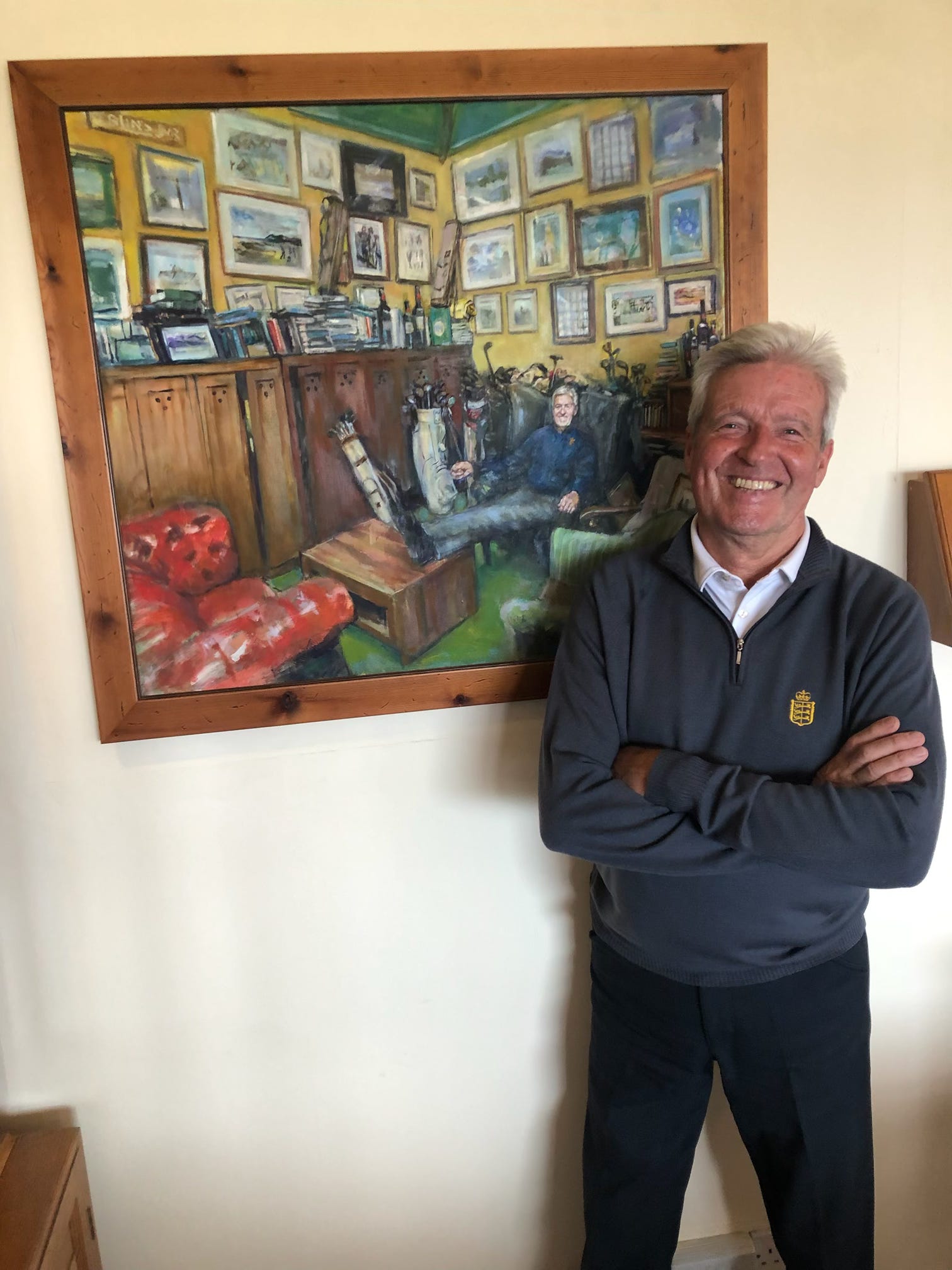
Deal’s well-loved head professional — Andrew Reynolds
The walls were hung with historic photographs of club members, British champions, rare golf art and framed personal memorabilia, a living museum of modern golf history packed into one man’s inner sanctum highlighted by an ancient work table freighted with the timeless tools of traditional club-making.
“I like to tell visitors that I’m a serious golf collector,” Reynolds explained with a laugh. “My wife Sue, however, says I’m merely a golf hoarder. She may be right.”
“Not many places like this left in the world of golf anywhere,” Patrick was moved to say. “Like stepping back in time.”
“That’s no accident. I come from a generation of pros who could make a golf club from scratch and knew everything about a member’s personality and playing abilities. Moreover, our like knew the rules inside and out, loved teaching the game, and could play it well. Seventy-hour work weeks were common in those days, all in service to members and their guests, fueled by a love of the game’s traditions and character.”
He sighed, smiled. “I’m afraid the profession is rapidly changing and many of those singular traditions are slipping away. The character – and characters – are vanishing from the game. Many club pro shops these days are reduced to merely retail outlets with some bird in a tight black T-shirt selling Peter Millar shirts for a hundred quid. I sell them, too, but I also sell nice golf shirts for thirty pounds and know almost everything there is to know about our members’ tastes. It’s all about service.”
We asked about his beginnings in the game and learned that Reynolds grew up in rural Surrey playing all sports and took up golf at age sixteen, caddying at Sunningdale and eventually nabbing an assistant professional’s post at The Berkshire Golf Club. He earned his PGA Tour Card in 1978 and tried his luck at several professional Tour events “but always came up one stroke shy of being in the money.” Not long after he gave up Tour life, he saw a notice that Royal Cinque Ports was looking for a new head man.
“I was just 23. I applied and they invited me down for an interview with a colorful member named Gordon Taylor, a character with a fifty-four-inch waist they called Thunder Belly, a worldclass boozer who reportedly once drank a hundred gin and tonics in a single day. Gordon was a lovely fellow with a marvelous sense of humor. Some years later, I asked him why he gave me give me the job at such an important club, as I was so very young.”
“It’s simple, my good man,” Taylor told him. “Three reasons. The first was, you came to the office ten minutes before your allocated time and boldly declared, ‘I’m Reynolds and I’ve come for the job.’ We liked that. This was 10:30 in the morning. By seven that evening you were still standing upright from drinking all day. We realized you had a lot of stamina. That also impressed us. The members liked you right off.”
“That’s because,” our host summed up, “I walked into the club bar – probably the best in England – and declared, ‘Good morning, gentlemen. I’m Andrew Reynolds, your new pro. Who would like a drink?’ Suddenly, I was everyone’s best friend. It cost me about forty quid, but it was a very good investment. Wonderful friendships evolved. This became my home for the next forty-five years.”
“So, how will it be to leave here in a month?” Patrick asked.
“Terribly difficult, I’m afraid. Deal owns my heart. But there is a definite upside.” He paused and added, “Let’s go over the bar and get a drink and I’ll show you around the clubhouse Walter Hagen never got to see.”
Following a charmingly narrated a tour that featured a statue of my hero Harry Vardon and a framed letter from Queen Elizabeth’s Royal Secretary politely inquiring how to properly pronounce the name “Royal Cinque Ports,” we settled over excellent gin & tonics in honor of Gordon Taylor and learned that the club planned to honor England’s longest serving head professional by making him captain of the club, a rare honor.
“Needless to say,” said Reynold, “I couldn’t be more grateful. And so is my wife, Sue, whose feet I won’t be under in retirement!”
He confided a wish, however, that his late friend Gordon was still alive and celebrate the moment and gave us a final Thunder Belly story tailor-made for longtime golf pals.
An elderly Deal member named Tugby, he explained, discovered that his best friend Gordon Taylor was on his deathbed at a local hospital.
“Deeply alarmed, Tugby rushes off to the hospital ward and pulls back a curtain and sits at the end of his dying friend’s bed. He begins rattling on with one memory after another, recounting their many trips and crazy adventures over the decades… but alas, gets no response at all. Tugby touches his friend’s hand but finds it frighteningly cold. In a panic he rushes off to find the ward nurse and declares: “I don’t think Mr. Taylor is all all well. In fact, he’s stone cold!”
They hurry back to the patient.
“This isn’t Mr. Taylor,” the nurse informs Tugby. “This gentleman died twenty minutes ago.”
Here our host paused with impeccable timing. One reason Reynolds is a perpetual hit on television and the club dinner circuit.
“Gordon was actually in the next bed, crying with laughter – which may have been what finally did him in. He clearly loved it, amused by his best friend to the end. As it happened, I was Gordon’s executor. Sue and I went to see him later that day and he told us to never forget this wonderful story. He died two days later. I miss his spirit and great sense of humor.”
He sipped his drink and looked at Patrick and then at me.
“That’s what golf gives us, you know – friends to the grave.”
We lifted our g+t’s to such a fine idea — and the memory of our own spirited golf pal Barry Wetzel, who left Patrick a witty barb as he loosed the bounds of Earth.
“That is a terrific story,” Reynolds agreed. “It prove my point.”
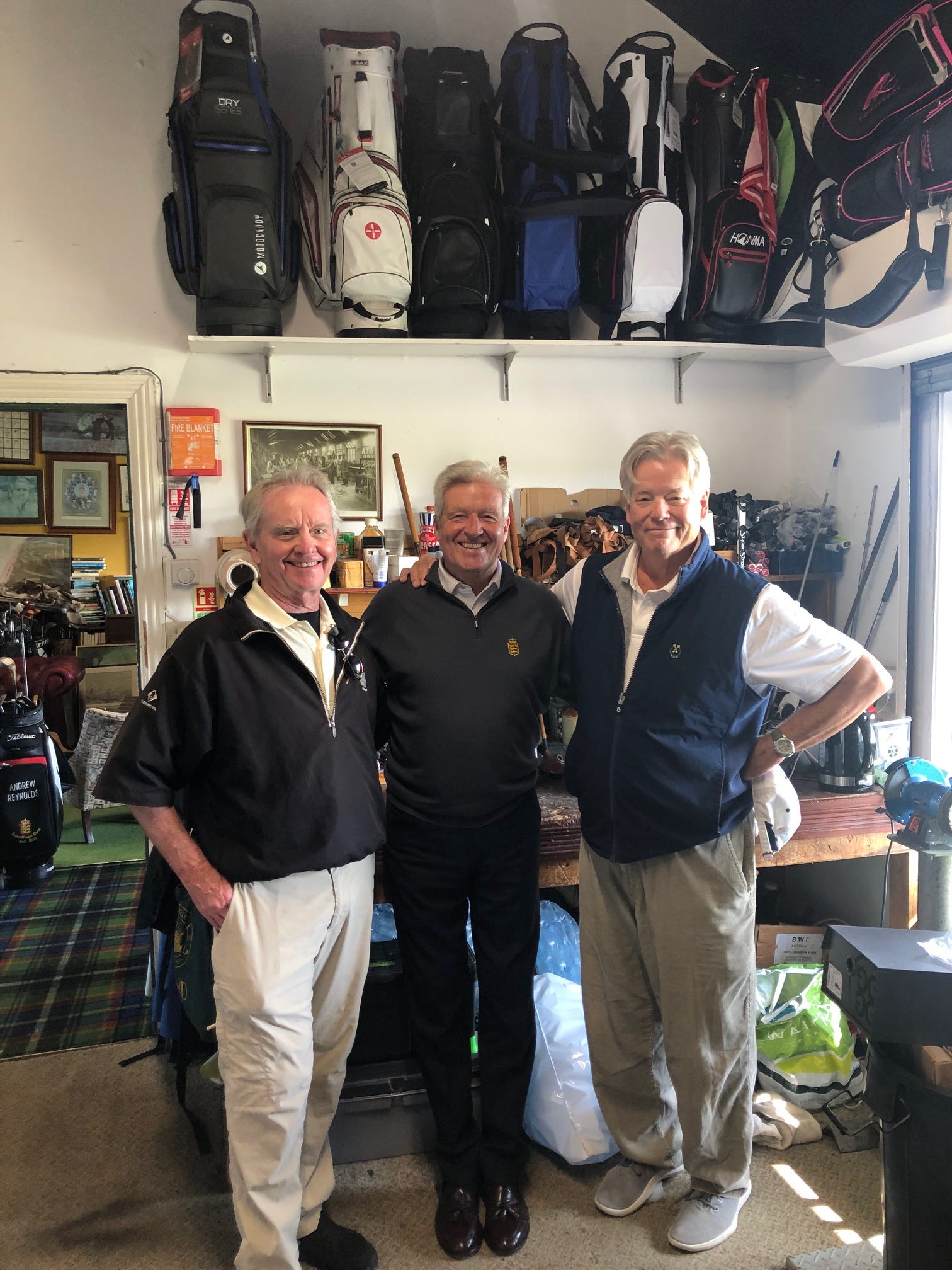
Three friends to the Grave
THERE WAS NOT a cloud in the sky over the English Channel the next afternoon when Reynolds arranged for an American member to play with us. His name was Bob, a super friendly fellow from Wisconsin who’d married a British woman and moved to Deal twenty years ago. “With 800 regular members and fifty overseas members,” he said, “that’s about how long it took me to become a member.”
He wondered if we’d ever played the course.
I confirmed that we had not, but we knew its wonderful story and we excited to play it on such a fine afternoon.
“There’s no other course quite like. Deal is a brute, even on a day like this.”
And with that, he recounted Walter Hagen’s miseries at the Open of 1920, adding a sweet detail we didn’t know.
“After his first round in the championship, a reporter asked Hagen what he thought of the golf course. He replied, ‘The front nine is a lot of fun, but not a lot of golf, while the back nine is a lot of golf – but not a lot of fun.’ You’ll see what he meant.”
Two years after The Haig pulled his famous stunt, the course was flooded again, requiring a major restoration project. The damage was severe enough for Deal to be temporarily dropped from the British Open Rota, though one year later it was fully recovered enough to host its first British Amateur Championship in which the great Roger Wethered beat Robert Harris 7 & 6. Deal was poised to host it third Open in 1938 when a fierce Southeast gale inundated the course so severely the R&A moved the Open just down the beach road to St Georges – never to return.
Despite similar floods in 1953 and 1972, Deal has hosted scores of important British amateur and professional events and frequently holds British Open qualifying. Dear to the hearts of many well-heeled British golfers, Deal is also home to the annual Halford-Hewitt Cup that is reportedly the oldest and largest amateur team event in the world.
Founded in 1924, the “Hewitt” is annually contested among 64 English and Scottish public schools that each field five foursomes pairs, making 640 competitors in all. My dear friend Charles Churchill of Westward Ho!, the former master of Summer Fields, who for decades accompanied teams of top English School boys to play matches at some of America premier layouts, once referred the Hewitt as an event where “middle-aged school boys relive their pasts with lots of golf, laughter, and abundant alcohol, perhaps the game’s most convivial house party.”
“The Hewitt is simply extraordinary. Nothing quite like it anywhere in golf, many days of great of rivalry and friendship,” said Bob as we strode along the first hole, a modest opener of 346 yards from the Club tee.
I wondered how members would feel about someday hosting another British Open.
“Oh, it would be fascinating to see how these modern pros would handle the challenge of Deal in any weather. But sadly, that will never happen. We’re something of a divine relic from the game’s golden past.”
Though a massive seawall prevents serious flooding these days, I wondered if Deal’s numerous ocean invasions and reputation as one of the sternest tests in golf has served to keep Royal Cinque Ports under the radar of the modern game.
He nodded. “That could well be. It may explain why members at Deal are such famously hearty drinkers. This course humbles everyone, regardless of skill and weather, and only a strong drink or two after the round can restore your happiness.”
With that preamble, following pars at the relatively tame first hole, we turned north and disappeared into the dramatic sand dunes and gently waving lark grass on a round that soon confirmed the wisdom of Sir Walter Hagen.
By the ninth hole, I found myself two holes down to Patrick and the weather sharply changing. As we putted out, the sun suddenly vanished, the wind rose, and the darkest clouds I’d seen in years rolled in from the sea.
Within minutes, a violent rain was upon us so intensely we bolted for the course’s halfway hut, where four other golfers were already sheltering. The mistress of the hut, a charming lady named Sheila, wondered if a warm cup of something called Shrovil would help us push on to the end.
“What’s that?” asked one of the sheltering golfers, a fellow American by his accent. He was shivering, I noticed. The temperature had suddenly dropped at least 20 degrees.
“It’s a drink very popular with members on days like this,” Shiela cheerfully explained. “Some insist it improves their games nicely.”
She glanced at the deadpan faces around the shed as the wind and rain loudly pelted the roof..
“Any takers?”
I spoke up just for fun, offering to try it.
She gave me a bright smile. “Good for you, dearie. It will put you right. That I promise.”
We watched as she mixed the concoction and placed it into the microwave for half a minute. “Not sure I want to know,” I asked. “But what exactly is in Shrovil?”
“A nice stout Sherry, some Bovril and a few other things,” she provided with a cryptic smile, handing me the warm paper cup. “It’s a tradition when the weather turns nasty at Deal.”
The group watched with suspended horror as I polished it off in one gulp.
“How is it?” someone anxiously asked.
“Not bad. It only smells worse than it tastes.”
And with that, Patrick and I plunged back into the tumult, he in his handsome new rain vest, me in my bright blue Royal Cinques Port rain jacket, heads bent low and soldiering on through the toughest back-nine I’ve ever played as the rain came in violent bursts.
By the time we’d reached the old Roman road that bisects the course at the 14th hole, we realized that Bob had mysteriously disappeared. We decided he’d had enough of our company or foul weather and fled for home without notice.
Fittingly, playing directly into the teeth of the gale at the par-five seventeen turned out to be the most difficult hole I’ve ever played, a buckling sea monster made of heaving turf with a tiny green that was all but invisible in an elevated hog-backed swale. Counting a pair of searches for golf balls donated to the lark sanctuary, we both required three more pokes just to reach the green, which I won when Patrick burst out laughing – and just picked his ball.
“Have you had enough, Mr. Eegen?” he shouted at me with his best club Secretary’s accent. “I’m almost out of golf balls.”
“See too.!” I shouted back.
At the eighteenth tee, however, the winds suddenly died off and a lone ray of sun shone brilliantly in our faces. An inch of water stood on the teeing ground and both of us were soaked to the bone.
Between us we’d lost more than half a dozen golf balls on the back nine, clearly a record for us both, but somehow I’d managed to win three holes that left me only two down in our ongoing match.
“What do you think?” I asked Patrick as we removed dripping caps, grinned, and shook hands on the suddenly sunny final green. Our disintegrating scorecard indicated that I’d somehow won the back nine.
“Unforgettable. Walter Hagen got it right.”
“So was Shiela. ThankGod for Bovril,” I said. “ The Haig could have used a slug of it!”
Just wonderful! What a ride!